Eyebrow Text Here
Lorem ipsum dolor sit amet elit
Lorem ipsum dolor sit amet, consectetur adipiscing elit, sed do eiusmod tempor incididunt ut labore et dolore magna aliqua. Ut enim ad minim veniam, quis nostrud exercitation ullamco laboris nisi ut aliquip ex ea commodo consequat. Duis aute irure dolor in reprehenderit in voluptate velit esse cillum dolore eu fugiat nulla pariatur.

AUTHOR'S NOTE
The purpose of this campaign memo is to provide support for the multitude of efforts by those engaged in the referendum campaign in support of Alberta remaining an integral part of Canada. Voter turnout is key to our success. That is all that matters in the next 4 weeks. We recognize that no single group will be able to implement all of my recommendations, but together, any efforts to mobilize voters for option A (remaining in Canada) will help achieve the desired outcome.
This document was prepared from our original outline and the variables we identified as important considerations in developing a roadmap for a Yes to Canada campaign. AI tools were used to help synthesize the Pollara research and organize this roadmap's structure, and to help draft messages and catchphrases. The analysis, strategic judgment and final content are the responsibility of the author and were reviewed and approved before circulation.
The strategy is informed by four research studies prepared by Pollara Strategic Insights, a national public-opinion research firm: a baseline survey (July 24–August 7, 2026) and three subsequent tracking waves, each reported as a rolling two-week sample — Wave 2 (August 27–September 2), Wave 3 (August 27–September 10), and Wave 4 (September 4–17). These are research reports available by subscription to selected Pollara clients, and findings drawn from them are referred to throughout this document as the Pollara research. Use of this research requires permission of Pollara Research.
EXECUTIVE SUMMARY - STRATEGIC SITUATION
The referendum is 4 weeks away (October 19), and these four weeks should now be treated primarily as a mobilization campaign. The most recent Pollara study, dated September 18, 2026, reports that 23% of decided voters would vote to SEPARATE.
REMAIN voters hold a consecutive motivation advantage, with 65% highly motivated compared with 62% of SEPARATE voters. Pollara reports that 91% of Albertans are committed to their current choice and unlikely to change their mind, up from 86% in the prior tracking period.
The central danger in this campaign is a combination of turnout complacency and protest voting: some Albertans may use the separation option to send Ottawa a message even if they do not truly want independence. The campaign must make clear that this is not a consequence-free protest.
The latest research continues to show uneven engagement. Women under 50 remain notably less engaged in referendum conversations, with only 26% reporting that they have discussed the referendum multiple times in the past month. Pollara also reports that REMAIN voters are more likely than SEPARATE voters to have already requested a mail ballot. Over 500,000 Special Ballots have already been requested.
Three Objectives

Strategic Approach
Do not try to persuade Albertans that everything about Confederation is working. Acknowledge legitimate Alberta grievances, but challenge separation as the remedy. The contest should not become Ottawa versus Alberta. It should become a strong Alberta in Canada versus the risk and uncertainty of separation.
MAKE THE CHOICE CONSEQUENTIAL. MAKE CANADA PERSONAL. MAKE THE COALITION BIGGER THAN POLITICS. TURN SUPPORT INTO VOTES.
EXECUTIVE SUMMARY - MESSAGE DELIVERY
30-Second Narrative
“We can be proud Albertans, disagree with Ottawa and still know that Alberta is stronger in Canada. Separation would mean years of uncertainty over jobs, investment, pensions, trade, borders and our economic future - at exactly the moment Donald Trump's tariffs and unpredictable behaviour make Canada's size and strength more important. This isn't a protest vote. On October 19, we can choose Alberta and Canada, and then get back to fighting for a stronger Alberta within Canada.”
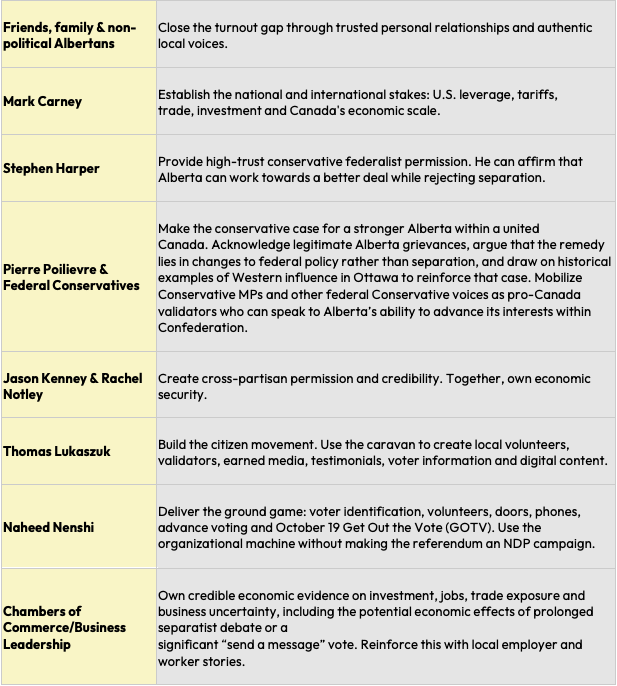
Key Messengers
Four-Week Campaign
- Week 1 - Make the choice real: economic risk, special ballots and the September 25 request deadline.
- Week 2 - Albertans speak: cross-partisan, conservative, business, worker and community validators.
- Week 3 - Make it personal: pensions, jobs, home equity, investment, taxes, trade, currency, borders, citizenship, passports, U.S. vulnerability and the cost of assuming national functions and obligations currently shared across Canada.
- Week 4 - Turn support into votes: advance voting October 13-17, regional organizing, community Get Out the Vote (GOTV) and a final 72-hour turnout operation.
Immediate priority: strongly encourage eligible supporters to request a special ballot before September 25, using Elections Alberta as the authoritative source for application and voting information.
Elections Alberta special ballots: Request a Special Ballot
1. STRATEGIC SITUATION AND TARGET AUDIENCES
The research suggests the referendum is becoming less fluid. The September 18 study reports that 91% of Albertans are committed to their current choice and unlikely to change their mind, up from 86% in the prior tracking period. The decided SEPARATE vote is 23%, while REMAIN motivation to vote is at 65% and SEPARATE motivation is 62%.
Priority Audiences
- Women under 50, especially mothers: The latest study identifies them as a particularly low-engagement turnout group, less likely to be discussing the referendum or hearing from campaigns.
- Low-motivation REMAIN voters: younger voters (especially under 35, moms), renters, lower-income voters, blue-collar and service workers, private-sector union workers and voters with lower formal education.
- Conservative federalists: Albertans who dislike Ottawa or the federal government but do not truly want to leave Canada.
- Protest voters: people considering separation primarily to send Ottawa a message.
- Regional soft voters outside Calgary: where separatist sentiment is comparatively stronger and federalist motivation can be softer.
- Culturally diverse communities: where trusted local messengers and practical voter information can materially improve participation.
Latest Polling Snapshot - September 18
Pollara's Wave 4 tracker conducted interviews between September 4-17 among 1,014 adult Albertans. It reports 73% of voters for REMAIN and 22% of voters for SEPARATE; 4% don’t know; 65% high motivation among REMAIN voters versus 62% among SEPARATE voters; 91% committed to their current choice.
Message Architecture
The research supports a hierarchy of Identity -> Security -> Pocketbook -> Practical Disruption. Canadian identity and the Trump/51st-state risk were the strongest tested REMAIN arguments in the baseline, followed by CPP, uncertainty and higher taxes. Concrete consequences outperform abstract institutional benefits.
The campaign should repeatedly distinguish grievance from remedy: Albertans can demand more provincial autonomy, oppose federal policies and fight for a better deal without assuming the economic and constitutional risks of separation.
Core Message Lines
- Ottawa doesn’t define Canada – we do.
- You can be angry with Ottawa and still vote to stay in Canada.
- This isn't a poll. This isn't a protest. This is a decision about Alberta's future.
- Alberta does not have to choose between being strong and being Canadian. It can be both.
- Uncertainty has a cost. Alberta does not have to separate for every Albertan to pay those costs.
2. ECONOMIC CONSEQUENCES AND THE TRUMP FACTOR
Economic uncertainty should be a dominant final-four-weeks theme because it translates an abstract constitutional question into household and business decisions. The argument must be evidence-based and avoid presenting modelled scenarios as guaranteed outcomes.
Economic Evidence
Publicly available Alberta business research provides useful scenario evidence. Calgary Chamber’s work with University of Calgary economist, Trevor Tombe, has modelled the potential effects of higher trade costs and a Brexit-like investment response, including materially lower investment, output and employment under adverse scenarios. Alberta Chambers research has also reported businesses already experiencing negative effects from separation uncertainty. Recent modelling from the University of Calgary’s School of Public Policy, published in its September 2026 report The Economic and Fiscal Implications of Alberta Separation, has also outlined the potential economic and fiscal costs of separation.
The messaging should therefore be less 'economic catastrophe is certain' and more: separation introduces risks that affect investment, hiring and household confidence before constitutional negotiations are even started.
Questions that Make Economic Personal
- What happens to mortgages, savings, home values and business financing during prolonged uncertainty?
- Will my employer expand or wait?
- What happens to my pension and retirement planning?
- What happens to interprovincial trade and market access?
- Will new investment come to Alberta or sit on the sidelines?
- What currency would Alberta use and who would control it?
- What happens to taxes and the cost of creating national institutions?
Trump, Tariffs and Canada's Scale
The Trump/U.S. dimension should be treated as a current strategic advantage, not a partisan anti-American message. The second Pollara study reports that Trump and tariffs are prominent among respondents who say recent events make them more likely to remain in Canada. The question for voters is practical: at a time of tariff threats and unpredictable U.S. behaviour, does Alberta have more leverage negotiating alone or as part of Canada?
The September 18 study finds that 13% say something in the past week made them more likely to vote REMAIN, while 11% say something made them more likely to vote SEPARATE. Respondents moving toward REMAIN cited economic costs and uncertainty, U.S.-Canada tensions and tariffs, Canadian identity and the view that Alberta is stronger within Canada. Those moving toward SEPARATE cited frustration with the federal government and Mark Carney, U.S. trade negotiations, federal policies, equalization, resource control, cost of living, immigration and healthcare. Pollara describes the U.S. relationship as cutting both ways.
Carney is best used on this terrain because his role allows him to discuss trade, investment, international markets and Canada's negotiating scale. His interventions should validate Alberta's importance rather than imply Ottawa is directing Alberta's choice.
3. MESSENGERS AND COALITION ROLES
Family and Friends
The research continues to identify family and friends as the most influential group that can mobilize people to come out and vote. Persuasion can create conflict, so their focus should be reminding the parents, brothers and sisters, and adult children how important this vote is to their family's future. Social media provides a unique opportunity to extend that outreach, allowing individuals to quickly and broadly share information and encourage participation across their own personal networks.
Mark Carney
Establish the national and international stakes: U.S. leverage, tariffs, trade, investment and Canada's economic scale.
Stephen Harper
The September 18 study reports Stephen Harper as the most trusted political messenger tested, with net trust of +25 overall and +17 among swing voters. His net trust is also positive among low-motivation REMAIN (+22) and low-motivation SEPARATE (+23) voters.
Pierre Poilievre & Federal Conservatives
Poilievre and the federal Conservative caucus can make a distinct argument to Albertans who are deeply frustrated with Ottawa but remain open to Canada. Poilievre has publicly described himself as a strong Canadian federalist and a proud Albertan, committed to campaigning for a stronger Alberta within a united Canada. Their role should be to validate concerns about federal policy while separating those grievances from the question of national unity.
The third research study shows why this role matters: Poilievre has strong net trust among swing voters and especially among low-motivation separatists. He and Alberta Conservative MPs should focus on the proposition that anger at federal policy can be resolved through political change inside Canada rather than national breakup.
Jason Kenney & Rachel Notley
Kenney and Notley should be used together to demonstrate that remaining in Canada is not a partisan position. Their political differences are the point: two prominent Alberta leaders who have fought each other over the direction of the province can still agree that separation creates unacceptable economic and constitutional risk. Joint appearances should concentrate on economic security, investment, jobs, pensions, trade and the practical consequences of prolonged uncertainty.
Thomas Lukaszuk
Build the citizen movement. Use the caravan to create local volunteers, validators, earned media, testimonials, voter information and digital content.
Naheed Nenshi
Deliver the ground game: voter identification, volunteers, doors, phones, advance voting, and October 19 Get Out the Vote (GOTV). Use the organizational machine without making the referendum an NDP campaign.
Chambers, Business Leaders and Other Business Groups
Chambers of Commerce, business leaders and other business organizations should be highly visible validators of the economic case for remaining in Canada, while avoiding the appearance of a single corporate-led political campaign. Their strongest contribution is to translate uncertainty into real Alberta decisions: whether companies invest, expand, hire, finance projects, locate head offices and retain skilled workers. Chambers can provide credible research and local economic evidence; CEOs, entrepreneurs, small-business owners, energy leaders and employers can explain what uncertainty means inside an actual business; and sector associations can show how separation could affect trade, supply chains, market access and investment. The most persuasive public events should mix large and small businesses, employers and workers, and voices from communities across Alberta rather than relying only on prominent corporate executives.
4. GROUND GAME, DIVERSE COMMUNITIES AND RELATIONAL TURNOUT
Ground Game
The field operation should move from Identify -> Commit -> Vote. Every supportive conversation should end with a voting plan:
- Will you vote?
- When will you vote?
- Where will you vote?
- Can you vote early?
- Who else in your household needs a reminder?
The September 18 study continues to identify lower engagement among women under 50. It also describes low-motivation REMAIN voters as including younger adults, mothers, service workers, renters, lower-income and lower-education voters, and racialized voters.
Once advance voting begins, the goal should be to bank as much identified REMAIN support as possible, and to concentrate volunteer effort on supporters who still need to vote.
Friends and Family
The September 18 study again finds friends and family to be the most trusted voices tested on separation, with net trust of +69 overall and +48 among swing voters.
Culturally Diverse Communities
The objective should be participation through trusted community networks. Work through community associations, local media, business leaders, neighbourhood networks and other trusted institutions. Provide accurate multilingual voting information where language is a practical participation barrier.
Use respected Albertans from those communities rather than outside political spokespeople whenever possible. The message remains economic security, Canadian belonging and participation; the messenger and communications channel become local.
Special Ballots
Make September 25 the campaign's first turnout deadline. The September 18 study reports that 27% of REMAIN voters and 14% of SEPARATE voters say they have already requested a mail ballot. A further 5% of REMAIN and 6% of SEPARATE voters say they plan to vote by mail but have not yet requested one. Pollara reports that about 85% of those planning to vote by mail have already requested their ballot, and that seniors show the highest interest in mail voting.
Advance Polls
Advance polls are the next opportunity to deliver the pro-Canada vote to the ballot box. They are scheduled for October 13 to October 17. For many voters who want to avoid long lineups on election day and did not request a special ballot, this is the most convenient and flexible way to register their decision. It is important for those aligned with the Remain campaign need to spread this content to their supporters.
DON'T WAIT FOR OCTOBER 19. SECURE YOUR VOTE.
5. PUBLIC RESEARCH AND OUTSIDE-ALBERTA SUPPORT
Research as Campaign Content
The fourth Pollara study, dated September 18, 2026, reports a 23% decided SEPARATE vote; a 65% to 62% REMAIN motivation advantage; 91% commitment to current choice; continued lower engagement among women under 50; Harper as the most trusted political messenger tested; friends and family as the most trusted voice overall; and higher reported mail-ballot requests among REMAIN voters.
Further Research Required
- Durability of REMAIN's new motivation advantage and whether the Trump effect continues to mobilize lower-motivation supporters.
- Engagement, contact rates and voting intentions among women under 50, including mothers.
- REMAIN/SEPARATE intention and intensity; likelihood of voting; regional turnout risk.
- Size and motivation of the protest-vote universe.
- Advance-vote intentions.
- Impact of Trump/tariffs and U.S. vulnerability.
- Response to economic-risk scenarios and uncertainty framing.
- Effectiveness of prominent validators.
- Trust in business, workers, friends/family and community leaders.
- Testing 'This isn't a protest vote' and 'You can be angry and still vote Canada.'
Canadians Outside of Alberta
Their role should be emotional and supportive, not directive: 'We want Alberta with us.' Use people with authentic Alberta connections where possible, including prominent Canadian cultural and public figures who can speak personally about Alberta’s importance to Canada. Avoid lectures, threats or the appearance that outsiders are managing Alberta's decision.
6. FOUR-WEEK CAMPAIGN ROADMAP

7. SIX QUESTIONS EVERY ALBERTANS SHOULD ASK BEFORE VOTING
- Am I voting because I genuinely want Alberta to leave Canada — or because I want to send Ottawa a message?
- At a time of tariffs and unpredictable behaviour from the United States, would Alberta have more negotiating power on its own — or as part of Canada?
- Who would pay my pension, and what would happen to my CPP benefits during and after negotiations?
- What would separation mean for my job, my savings, my mortgage, and Alberta's trade with the rest of Canada — and how long would that uncertainty last?
- If I'm frustrated with Ottawa, is leaving Canada the only way to demand a stronger Alberta — or can Alberta fight for a better deal while remaining Canadian?
- When I look beyond today's governments and political leaders, what country do I want Alberta to be part of 10, 20 and 50 years from now?
This isn't a poll. It isn't a protest. It's a decision about our future. Know what you're voting for.
8. CONCLUSION
The Stay-in-Canada side begins with an important underlying advantage, but the referendum will not be won by assuming that advantage automatically produces a decisive result. The final four weeks must turn broad support into committed participation.
MAKE THE CHOICE CONSEQUENTIAL
Beginning a separation process creates economic, constitutional and personal uncertainty. Voters should understand that a protest ballot can have real consequences.
MAKE CANADA PERSONAL
Canada is more than Ottawa or the government of the day. It is family, citizenship, opportunity, security, identity and belonging. How is this decision going to affect my family and my friends?
MAKE THE COALITION BIGGER THAN POLITICS
Ordinary Albertans and friends and family make the case authentic; Harper provides high-trust conservative federalist permission; Carney establishes national and international stakes; Kenney and Notley demonstrate cross-partisan Alberta agreement; prominent Conservatives reinforce that permission; Lukaszuk builds the movement; Nenshi delivers organizational turnout; Chambers own economic evidence.
TURN SUPPORT INTO VOTES
Use special ballots, advance voting, doors, phones, community networks and friends-and-family organizing to ensure that people who want Alberta to remain in Canada actually cast a ballot.
Alberta does not have to choose between being strong and being Canadian. We can be both.
On October 19, the objective is to ensure that every Albertan who believes this actually votes.